How Much Does It Cost to Build an On-Demand Grocery Delivery App in India? (2026 Pricing & ROI Breakdown)

A transparent 2026 breakdown of on-demand grocery delivery app development costs in India — from ₹3.5L MVPs to ₹28L platforms — plus the hidden running costs and ROI math founders miss.
Most founders chasing the next BigBasket clone get sticker shock from the wrong number. They obsess over the development quote and ignore the per-order unit economics that actually decide whether the app survives 18 months. I've watched ₹14 lakh apps die quietly because nobody budgeted for the third delivery rider's incentive structure.
Here's the honest spread: a launch-ready on-demand grocery delivery app in India costs between ₹3.5 lakh and ₹28 lakh in 2026, depending on whether you're testing a hyperlocal pilot or building a multi-city platform with dark-store inventory sync.
The Three Real Cost Bands (Not the Inflated Agency Tiers)
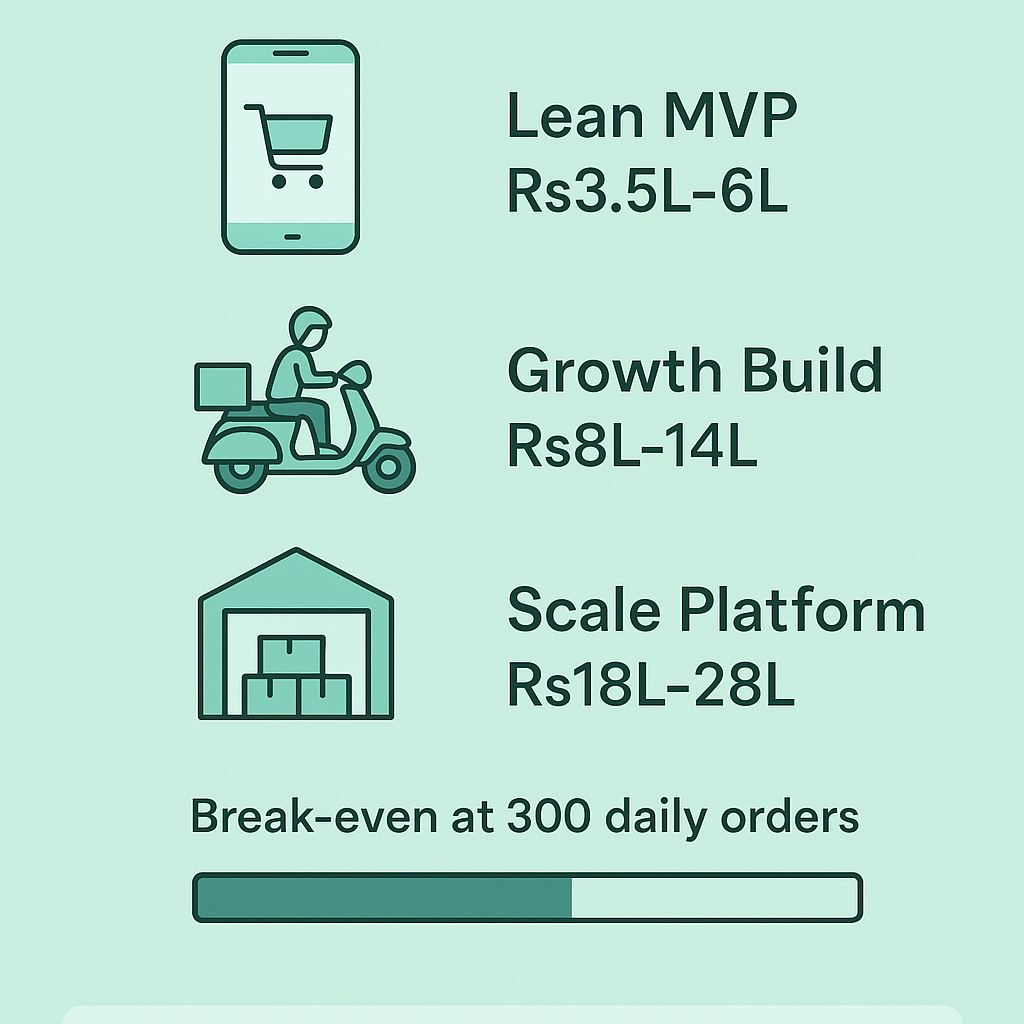
A functional grocery delivery MVP in India runs ₹3.5–6 lakh; a market-ready app with live tracking and payment gateways lands at ₹8–14 lakh; an enterprise-grade platform with predictive inventory hits ₹18–28 lakh. The gap is feature depth, not "better code."
Lean MVP (₹3.5L–₹6L): Customer app + basic admin panel, manual order assignment, single store, Razorpay integration.
Growth Build (₹8L–₹14L): Customer + delivery partner + vendor apps, real-time GPS tracking, slot-based delivery, loyalty wallet.
Scale Platform (₹18L–₹28L): Multi-vendor marketplace, AI demand forecasting, dark-store logic, ERP/POS sync, fraud detection.
Pro Tip: Roughly 68% of first-time founders overspend on the customer app and underspend on the delivery-partner app. Riders abandon clunky interfaces fast — and a single rider churning costs you ₹4,000–₹7,000 in re-onboarding and lost delivery capacity.
Where Your Money Actually Goes: A Line-Item Teardown
Development labour eats 55–65% of your budget; the rest splits across design, third-party APIs, infrastructure, and the silent killer — post-launch maintenance. Here's the granular breakdown for a typical ₹11 lakh Growth Build:
UI/UX design & prototyping: ₹1.1L–₹1.6L (Figma flows, micro-interaction mapping)
Customer-side app dev: ₹3L–₹4L (catalog, cart, slot booking, reorder logic)
Delivery partner app: ₹1.5L–₹2L (route optimisation, COD reconciliation)
Admin & vendor dashboard: ₹1.5L–₹2L (inventory, payouts, analytics)
Backend & API architecture: ₹1.5L–₹2.5L (the part that breaks at scale)
QA, deployment, store submission: ₹40k–₹70k
The architecture decision matters more than anyone admits. A poorly structured backend forces a ₹6 lakh rewrite around the 50,000-order mark — I've audited three startups stuck in exactly that trap. Solid backend logic borrows the same discipline as a high-converting business website: invisible until it fails.
Native vs Cross-Platform: The ₹4 Lakh Decision
Cross-platform development with Flutter or React Native cuts your build cost by 30–40% versus separate native iOS and Android apps, because one codebase serves both. For grocery delivery specifically, this is almost always the smarter spend.
Native makes sense only when you need bleeding-edge hardware access — and grocery apps rarely do. A Flutter build for the Growth tier saves roughly ₹3.8 lakh and shaves 6–8 weeks off your timeline. That speed-to-market advantage compounds: launching one quarter earlier in a hyperlocal zone can capture a 22% first-mover retention edge before competitors arrive.
Warning: Beware agencies quoting "₹99,000 grocery apps." These are reskinned templates with shared backends — your customer data sits on a multi-tenant server you don't control. When 400 concurrent users hit it during a Sunday rush, the app stalls and your refund rate spikes past 15%.
The Recurring Costs Nobody Quotes You Upfront
Monthly running costs for a live grocery app range from ₹18,000 to ₹85,000, covering cloud hosting, payment gateway fees, SMS/OTP, map APIs, and maintenance. These never appear in the development invoice — yet they determine survival.
Cloud infrastructure: ₹8k–₹40k/month (scales with order volume)
Google Maps API: ₹5k–₹22k/month (live tracking is expensive at scale)
Payment gateway: 1.8%–2.4% per transaction
SMS/push notifications: ₹3k–₹12k/month
Maintenance retainer: 15–20% of build cost annually
Pair this with a marketing engine. An app nobody downloads is a ₹11 lakh paperweight, which is why smart founders bolt on lead generation funnels and a fast landing site from day one. Your app's discovery often starts on a webpage, so don't skip the speed-optimised companion site.
The ROI Math That Justifies the Spend
A well-run hyperlocal grocery app breaks even at 280–350 daily orders, assuming a ₹55–₹75 blended margin per order after delivery and discount costs. Below that threshold, you're subsidising every basket.
Run the numbers on a ₹11 lakh Growth Build: at 300 daily orders × ₹65 margin × 30 days, you net ₹5.85 lakh monthly gross profit. Subtract ₹65,000 in running costs and you recover your full build inside two to three months — provided customer acquisition cost stays under ₹140.
That CAC ceiling is the whole game. The startups that fail aren't the ones with expensive apps; they're the ones burning ₹400 to acquire a customer worth ₹180. Lock your retention loops — reorder nudges, wallet cashback, slot reminders — before you scale ad spend. Treating your app like an evolving asset, the same way AI-driven startup models iterate weekly, separates the survivors.
How to Cut 40% Without Cutting Quality
You slash cost by phasing features, not by hiring cheaper developers. Launch a single-store MVP, validate demand in one pin-code cluster, then reinvest revenue into the multi-vendor build. This staged approach defers ₹4–6 lakh of spend until the model proves itself.
Skip the custom delivery-rider hardware. Skip the loyalty tiers until you have repeat buyers. Skip native iOS if 78% of your target users are on Android — which, in tier-2 Indian cities, they almost always are. Every deferred feature is cash that survives to fund marketing.
The founders who win treat the first build as a hypothesis, not a monument. Spend ₹5 lakh to learn what your customers actually do — then spend the next ₹15 lakh with surgical confidence.
Ready to Get a Transparent Quote?
Stop guessing at numbers from random agencies. We'll map your exact feature set, timeline, and running costs into a no-fluff proposal — and tell you honestly if an MVP is smarter than a full build.
📞 Phone: +91 8888 589767
✉️ Email: sales@jikut.com
hello
Written by
Vikas Giri
Founder & Content Creator
Related Tags
Comments
Loading comments...
Leave a Comment
THERE'S MORE TO READ

Founder Calendar Fragmentation: Why Your 14 Half-Hour Meetings Leave Zero Deep Work (And the Time-Blocking Ritual That Reclaims It)
Fourteen scattered meetings leave founders just 42 minutes of real deep work. Here's the meeting-compression ritual that defrags your calendar and reclaims 500+ strategic hours a year.
How Much Does Instagram Reels Editing Cost in India? (2026 Per-Video Pricing & ROI Breakdown)
A transparent 2026 breakdown of Instagram Reels editing costs in India—from ₹800 raw cuts to ₹8,000 concept-to-post packages—plus the ROI metrics that actually matter.

Baseline Profile Neglect: Why Your Android App Runs 30% Slower Than It Should (And the JIT-to-AOT Fix Nobody Ships)
Most Android apps ship without baseline profiles and eat a silent 20–30% cold-start penalty. Here's the JIT-to-AOT fix, verification steps, and maintenance strategy pros actually use.