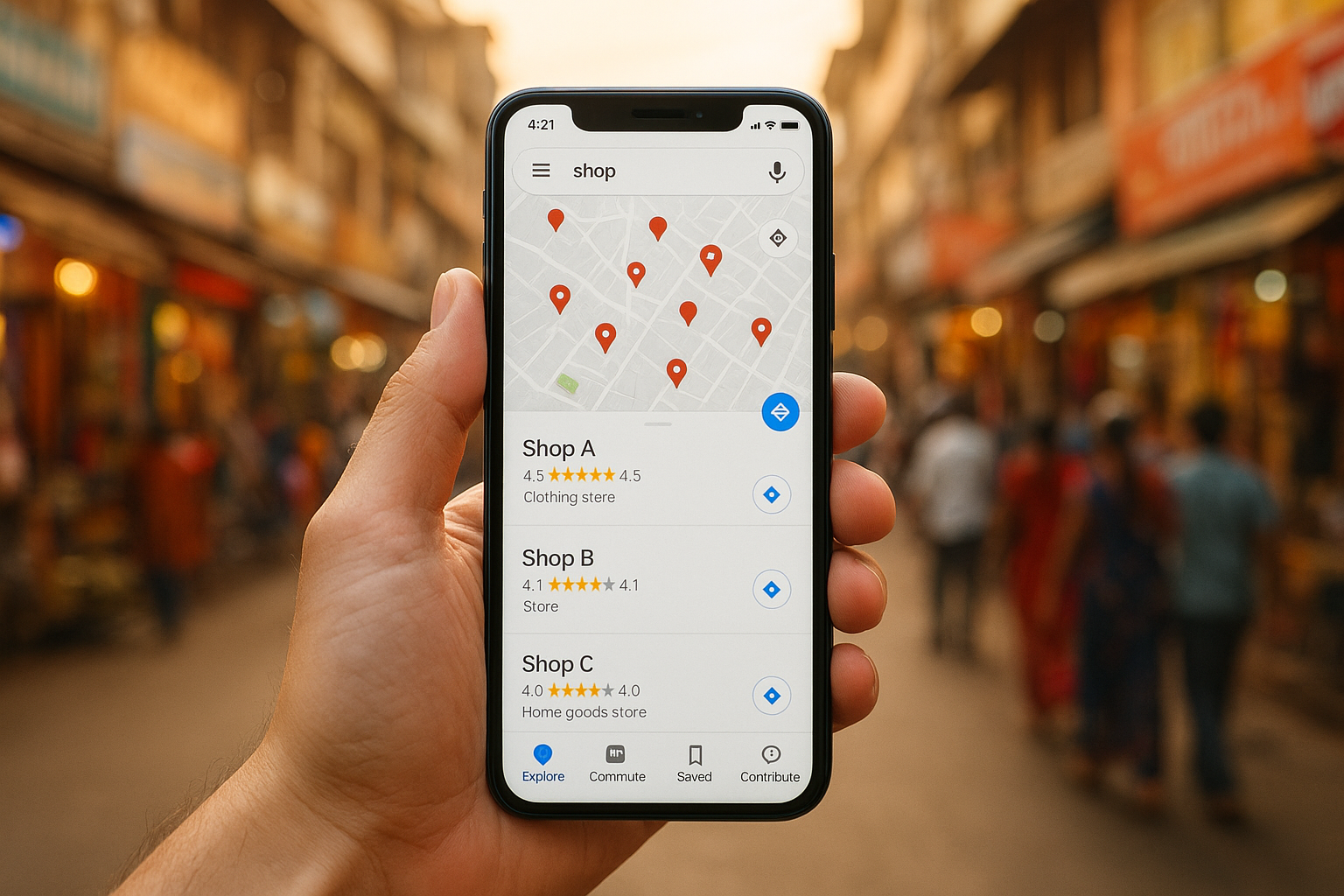
Local SEO 101: How to Make Your Shop Show Up When Locals Search on Google

A no-fluff playbook for getting your physical shop into Google's Map Pack using NAP consistency, "near me" intent mapping, and mobile-first fixes that actually move the needle.
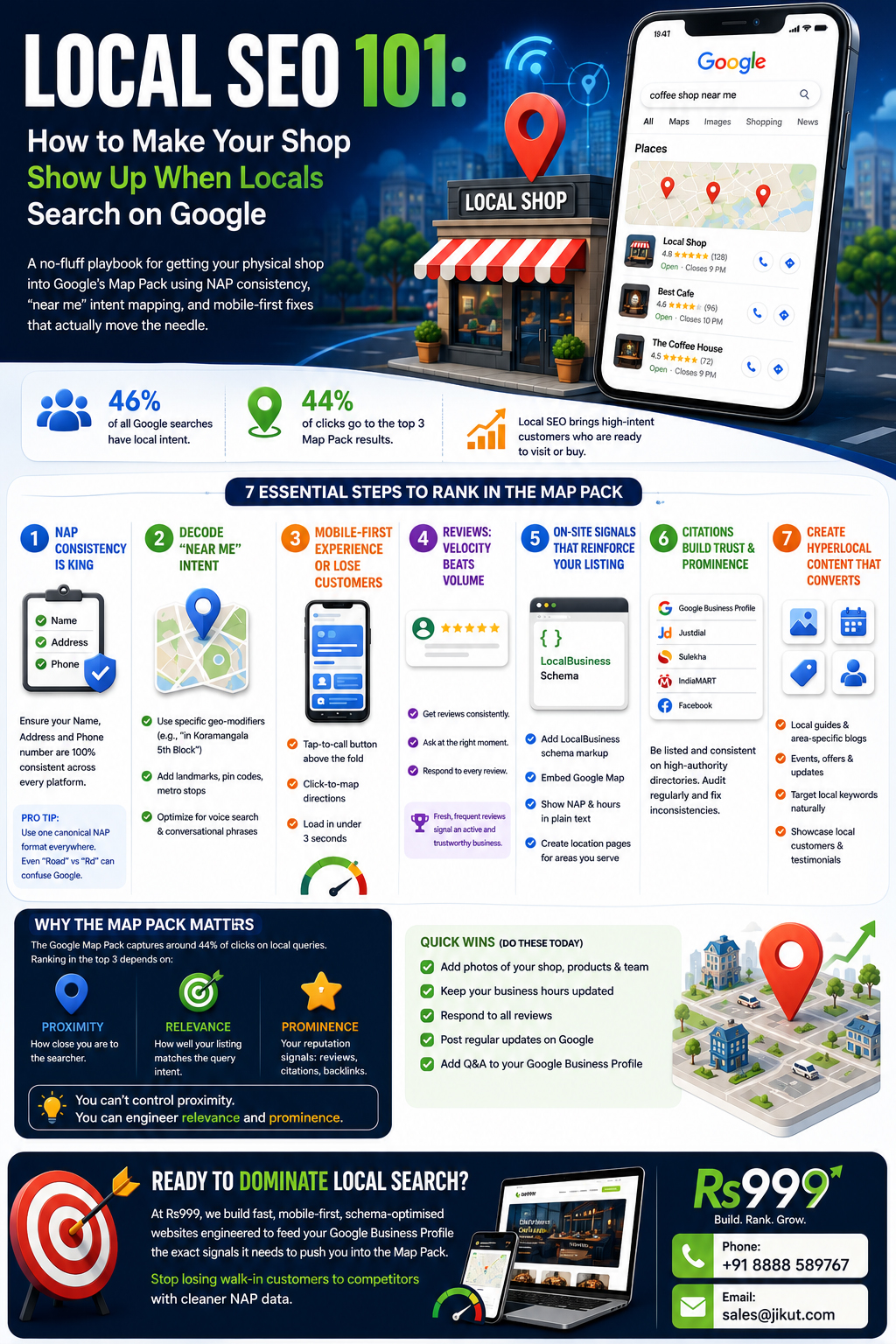
Here's a number that should sting: roughly 46% of all Google searches carry local intent, yet most shop owners spend their entire budget chasing keywords that bring customers from three cities away. You don't need traffic from Delhi if your samosa counter is in Indiranagar.
Local SEO isn't a watered-down version of "real" SEO. It's a separate ranking engine with its own physics — proximity, prominence, and relevance — and the businesses that understand this quietly eat their competitors' lunch.
Why the Map Pack Is the Only Real Estate That Matters
The Google Map Pack (those three pinned results above the organic listings) captures around 44% of clicks on local queries. Everything below it fights over scraps.
Ranking in those three slots depends on a trio Google weighs constantly:
Proximity — how close you are to the searcher's GPS coordinates.
Relevance — how well your listing matches the query intent.
Prominence — your reputation signals: reviews, citations, backlinks.
You can't control proximity. You can ruthlessly engineer relevance and prominence — and that's where 90% of shops leave money on the table.
NAP Consistency: The Boring Fix That Beats Everything
NAP stands for Name, Address, and Phone number. Google treats your NAP as your business's fingerprint across the web. When that fingerprint is inconsistent, the algorithm gets nervous and demotes you.
I once audited a Pune bakery losing to a newer rival. Their address appeared seven different ways across Justdial, Facebook, and their website — "Shop 4" vs "Unit-4" vs "#4". Fixing it pushed them into the Map Pack within five weeks. No new content. Just consistency.
Pro Tip: Pick one canonical NAP format and enforce it everywhere — including the abbreviation style. "Road" and "Rd" are two different entities to a crawler that doesn't trust you yet.
Run a citation audit across these high-authority Indian directories: Google Business Profile, Justdial, Sulekha, IndiaMART, and Facebook. Standardise every single one. This unglamorous task outperforms most "advanced" tactics — and it's exactly why a proper website beats relying on a Google Business Profile alone: your site becomes the authoritative NAP source everything else references.
Decoding "Near Me" Intent (It's Not What You Think)
Most owners stuff "near me" into page titles. Wasted effort. Google doesn't match "near me" as a literal keyword — it interprets the searcher's location and matches it to your relevance signals.
To win "near me" queries, optimise for what they actually mean:
Add explicit geo-modifiers: "organic café in Koramangala 5th Block" beats vague "best café near me" stuffing.
Use neighbourhood entities in your H1, body copy, and image alt text — landmarks, pin codes, metro stops.
Mirror conversational phrasing since voice search drives a chunk of these queries.
This dovetails with how AI search now works. If you're serious about future-proofing, study semantic SEO for AI search engines — entity clarity is the shared currency of both local and AI ranking systems.
Mobile Responsiveness Isn't Optional — It's the Gate
Over 60% of local searches happen on a phone, often while the person is walking toward a purchase decision. Google indexes the mobile version of your site first, so a clunky mobile experience tanks you before you even compete.
Three non-negotiables for local mobile:
Tap-to-call buttons above the fold — a customer mid-search won't hunt for your number.
Click-to-map directions wired to your exact verified pin.
Sub-3-second load times — every extra second drops conversions by roughly 7%.
Warning: Heavy hero images and lazy-loaded banners are a silent killer on mobile. If your layout jumps while loading, you're hemorrhaging customers — dig into fast-loading website tactics before you blame the algorithm.
Reviews: Velocity Beats Volume
A shop with 40 reviews collected steadily over six months frequently outranks one with 300 reviews that all stopped a year ago. Google reads review recency and velocity as a freshness signal.
Build a simple ritual: ask every satisfied customer for a review the moment they're happiest — at checkout, after delivery, on the walk out. A printed QR code linking straight to your review form converts 2-3x better than a verbal ask.
Respond to every review, positive or negative. Owner responses signal an active, legitimate business — a prominence factor most competitors ignore entirely.
On-Site Signals That Reinforce Your Listing
Your website and your Google listing should sing the same song. Add LocalBusiness schema markup with your NAP, opening hours, and geo-coordinates. This hands Google a machine-readable confirmation of who you are.
Embed your verified Google Map, list your hours in plain text (not just an image), and create a dedicated location page if you serve multiple areas. The goal is zero ambiguity. Remember, even small shops can outrank chains here — I've detailed exactly how local shops beat big brands with simple websites using precisely these signals.
Conclusion
Local SEO rewards discipline over cleverness. Lock down NAP consistency, decode genuine "near me" intent with real geo-entities, nail mobile speed, and keep reviews flowing fresh. Do these four things relentlessly and the Map Pack opens up — no black-hat tricks required.
The shops that win aren't the ones with the biggest budgets. They're the ones whose digital fingerprint is clean, consistent, and impossible for Google to misread.
Ready to Dominate Local Search?
At Rs999, we build fast, mobile-first, schema-optimised websites engineered to feed your Google Business Profile the exact signals it needs to push you into the Map Pack. Stop losing walk-in customers to competitors with cleaner NAP data.
📞 Phone: +91 8888 589767
✉️ Email: sales@jikut.com
Written by
Vikas Giri
Founder & Content Creator
Frequently Asked Questions
+−How long does it take for a new shop to rank in the Google Map Pack?
+−Does my street address really need to match exactly across every directory?
+−Can I rank for "near me" searches without physically being near the searcher?
+−How many Google reviews do I need to outrank a competitor?
+−Does embedding a Google Map on my website actually help local rankings?
+−Will a slow-loading mobile site hurt my local rankings?
+−Should small shops bother with location landing pages if they have one outlet?
Comments
Loading comments...
Leave a Comment
THERE'S MORE TO READ
How Much Does Instagram Reels Editing Cost in India? (2026 Per-Video Pricing & ROI Breakdown)
A transparent 2026 breakdown of Instagram Reels editing costs in India—from ₹800 raw cuts to ₹8,000 concept-to-post packages—plus the ROI metrics that actually matter.

Anti-Aliasing Fringe Halo: Why Your Exported PNG Logo Grows an Ugly White Rim (And the Matte-Channel Fix Pros Nail)
That ugly white rim around your transparent PNG logo has a name and a fix. Learn why premultiplied alpha creates fringe halos and how pros export edge-perfect graphics.

Zero-Click Cannibalization: Why Your Best SEO Content Is Answering Questions That Never Send You Traffic
Your best SEO content might be ranking beautifully while sending zero traffic—here's how zero-click cannibalization works and the tiered-answer framework that fights back.