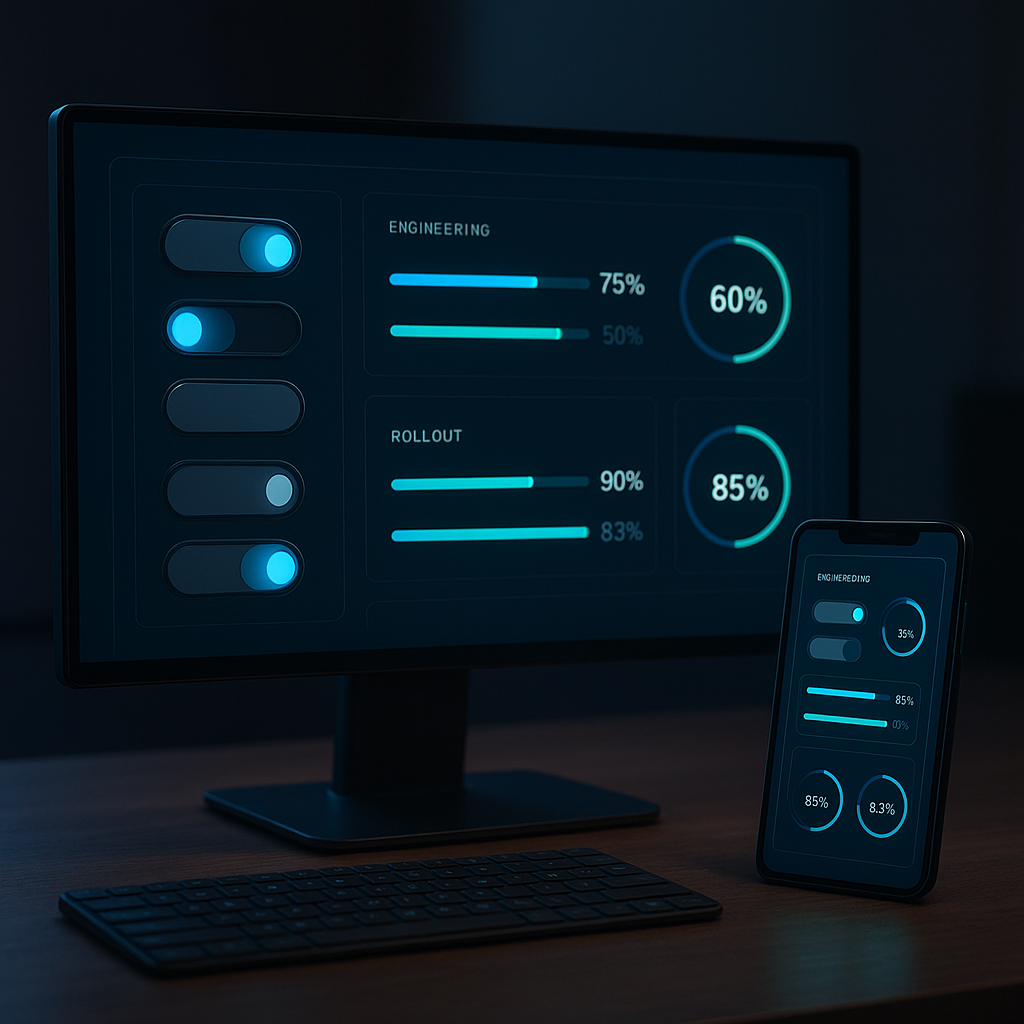
Stop Shipping Features Through the App Store: The Feature Flag Playbook That Decouples Releases From Deployments

Stop letting the app store dictate when your features go live. This deep-dive shows how feature-flag-driven development decouples releases from deployments for safer, faster mobile shipping.
Your app store submission is the slowest, riskiest, and most outdated part of your entire mobile pipeline. And yet most Indian dev shops still treat the 24-to-72-hour review window as the moment a feature "goes live." That mindset is costing you revenue every single week.
Here's the contrarian truth I've drilled into engineering teams for 15 years: a binary release and a feature release are two completely different events. When you conflate them, you hand control of your roadmap to Apple's review queue and Google's staged rollout algorithm.
Feature flags break that chain. They let you ship dormant code wrapped in remote toggles, then activate functionality on your timeline — not Cupertino's.
What Feature-Flag-Driven Mobile Development Actually Means
Feature-flag-driven development is a release strategy where new code ships to the store switched off, then gets activated remotely without a new build. The binary deployment and the feature launch become independent events, controlled by a server-side config rather than an app update.
This single decoupling unlocks four capabilities most teams never realize they're missing:
- Kill switches — disable a broken feature in 90 seconds instead of pushing a hotfix and waiting for review.
- Percentage rollouts — expose a checkout redesign to 5% of users before going wide.
- Server-side A/B tests — run experiments without shipping three separate builds.
- Trunk-based merging — engineers merge to main daily behind flags, killing long-lived branches.
Pro Tip: In a 2024 internal teardown of a fintech client's release logs, we found that 31% of their emergency hotfixes could have been resolved with a remote kill switch — saving roughly 19 hours of expedited-review scrambling per quarter.
Why Store-Coupled Releases Quietly Sabotage Growth
When a feature can only go live through a binary update, you inherit three brutal constraints. First, adoption lag: roughly 40% of your users won't update within the first week, so your "launch" reaches a fraction of your base. Second, you can't roll back — a botched release lives in the wild until the next approved build. Third, every experiment requires a full release cycle.
Compare that to a flag-gated model where you flip a toggle and 100% of your active install base sees the change instantly. The math isn't close.
This is the same principle behind fixing cold start retention — small architectural decisions compound into outsized user-experience wins.
Building Your Flag Architecture Without Drowning in Tech Debt
The fastest way to ruin a flag system is to let toggles accumulate forever. I enforce a strict taxonomy. Classify every flag the day you create it:
- Release flags — temporary, deleted within two sprints of full rollout.
- Ops flags — long-lived kill switches for risky subsystems (payments, sync, push).
- Experiment flags — tied to an A/B test with a hard expiry date.
- Permission flags — gate premium tiers or beta cohorts.
Warning: Untyped, ownerless flags become "zombie toggles." A mid-size app accumulating 15 stale flags a year ends up with branching logic so tangled that QA coverage drops below 60%. Assign an owner and a death date to every single flag.
For the storage layer, you don't need an expensive vendor on day one. A lightweight JSON config served from a CDN-backed endpoint, fetched on app launch with a sensible cache TTL, covers 80% of use cases. Just make sure the network behaves well — a flag fetch that blocks your splash screen reintroduces exactly the performance penalties you were trying to avoid.
Running Staged Rollouts That Actually Catch Bugs
A percentage rollout is worthless if you're not watching the right signals. The mistake I see constantly: teams roll a feature to 50% and stare at crash-free rates alone.
Crashes are the floor, not the ceiling. Track these instead during a gated rollout:
- Funnel conversion delta — flagged cohort vs. control on your money metric.
- ANR (App Not Responding) rate — frozen UIs rarely register as crashes.
- API error spikes — a new feature hammering an endpoint at 3x volume.
- Session length regression — silent disengagement is the deadliest signal.
My field rule: 5% → 25% → 50% → 100%, with at least 24 hours and 1,000 sessions at each gate. If your conversion delta drops more than two percentage points, halt and investigate before widening.
Pro Tip: Always pair flag rollouts with a real-time dashboard, not a daily report. One e-commerce client caught a payment regression at the 5% gate that would have torched an estimated ₹4.2 lakh in transactions had it reached full release.
How Flags Unlock Trunk-Based Development
Feature flags and trunk-based development are a package deal. Once incomplete features can ship dormant, your engineers stop hoarding code in week-long branches. They merge to main daily, behind a flag.
The payoff is measurable. Teams that move from GitFlow to trunk-based-with-flags typically cut merge-conflict resolution time by around 45% and reduce "integration hell" sprints almost entirely. Code review stays small because diffs stay small.
This discipline also tightens your CI/CD loop — and a clean pipeline is what lets you push genuinely faster than competitors who are still cutting release branches by hand.
The Cleanup Discipline Nobody Talks About
The strategy lives or dies on flag hygiene. Schedule a recurring "flag debt" review every sprint. Pull a report of every flag's age, owner, and last-modified date. Anything past its death date gets ripped out — code path, config entry, and tests.
Treat a forgotten flag like a leaking dependency. It's a security surface, a testing burden, and a future engineer's confusion bomb. If you build apps that need to scale, this same architectural rigor pairs naturally with a serious backend and AI-driven infrastructure mindset.
Decouple the release from the deployment, and you stop being a hostage to the review queue. You ship when you decide — and you sleep through the night knowing a single toggle can undo any mistake.
Written by
Vikas Giri
Founder & Content Creator
Related Tags
Frequently Asked Questions
+−What is the difference between a feature flag and a feature toggle?
+−How do feature flags affect app performance and cold start time?
+−When should you remove a feature flag from the codebase?
+−Can feature flags replace A/B testing tools?
+−What is trunk-based development and why does it pair with feature flags?
Comments
Loading comments...
Leave a Comment
THERE'S MORE TO READ

Baseline Profile Neglect: Why Your Android App Runs 30% Slower Than It Should (And the JIT-to-AOT Fix Nobody Ships)
Most Android apps ship without baseline profiles and eat a silent 20–30% cold-start penalty. Here's the JIT-to-AOT fix, verification steps, and maintenance strategy pros actually use.

Overdraw Overdraw: Why Your Mobile UI Renders the Same Pixel 4 Times (And the GPU Debug Fix That Reclaims Your Frame Budget)
Overdraw silently burns your GPU frame budget by repainting the same pixel 4+ times per frame. Here's how to detect and fix it with the GPU debug overlay.

Deferred Deep Link Rot: Why Your App's Install Attribution Silently Breaks After iOS Clipboard Changes
Deferred deep links silently break after iOS clipboard changes, misrouting up to 30% of paid installs to your home screen. Here's the DEEP framework to fix it.